
If you've been told dry needling could help your muscle pain, you've probably asked the obvious question: isn't that just acupuncture? Both treatments use the same kind of thin, sterile needle. But that's about where the similarity ends. They come from different traditions, aim at different targets, and feel different on the table.
Here's a plain-language breakdown of how dry needling and acupuncture compare, so you can decide which one fits your situation.
The Short Answer
Acupuncture is a traditional Chinese medicine practice that places needles at specific points along the body to restore the flow of energy, or qi. Dry needling is a modern, anatomy-based technique that places needles directly into tight bands of muscle, called trigger points, to release tension and reduce pain.
In other words, acupuncture works from an energy-system model of the body. Dry needling works from a muscle-and-nerve model.
What Is Acupuncture?
Acupuncture has been practiced for more than 2,000 years. In traditional Chinese medicine, health depends on qi moving freely through pathways called meridians. When that flow is blocked, the theory goes, pain or illness follows. Acupuncturists insert needles at specific points along those meridians to rebalance it.
Today, people use acupuncture for a wide range of concerns, including chronic pain, headaches, nausea, stress and sleep problems. Needles are usually left in place for 15 to 30 minutes while you rest. Most people feel little more than a light tingle or dull pressure.
In the United States, acupuncture is typically performed by a licensed acupuncturist (L.Ac.), who completes a dedicated graduate program in the practice.
What Is Dry Needling?
Dry needling grew out of Western research on myofascial pain, especially the work of physicians who mapped trigger points in the 20th century. A trigger point is a small, tight knot in a muscle that is tender to the touch and can send pain to other areas. A knot in your upper trapezius, for example, can cause a headache behind your eye.
It's called "dry" because nothing is injected. A trigger point injection delivers medication; dry needling uses only the needle itself.
During treatment, the provider finds the trigger point by hand and inserts the needle directly into it. This often causes a quick, involuntary muscle twitch, called a local twitch response. That twitch is a sign the knot is releasing. Needles may be in for a few seconds or left in for several minutes.
Dry needling is performed by trained providers such as chiropractic physicians and physical therapists. Training and scope-of-practice rules vary by state.
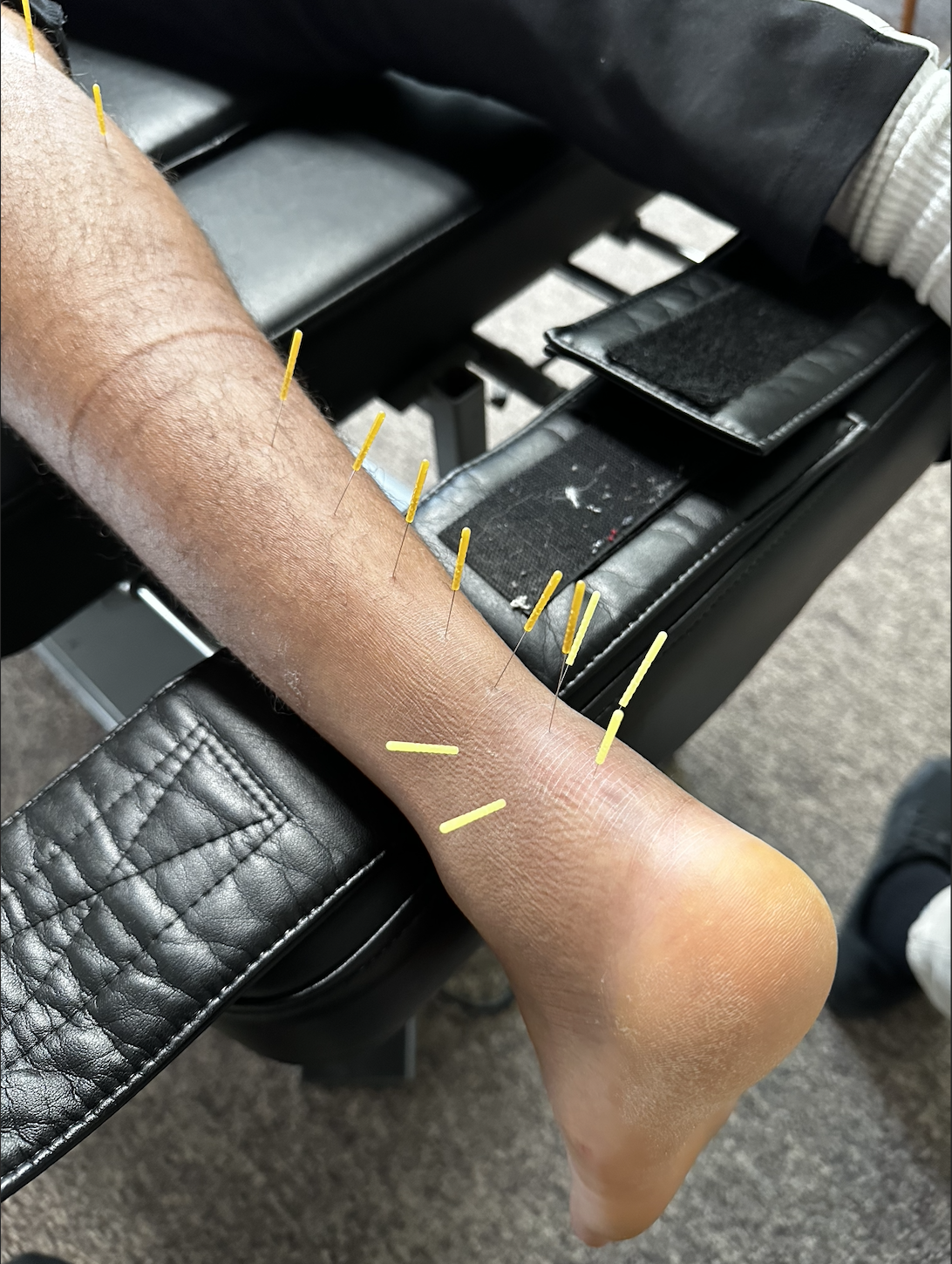
Dry Needling vs. Acupuncture: Side by Side
Origin: Acupuncture comes from traditional Chinese medicine. Dry needling comes from modern Western anatomy and pain research.
Goal: Acupuncture aims to restore the flow of qi. Dry needling aims to release trigger points and calm irritated muscles and nerves.
Where the needles go: Acupuncture uses mapped points along meridians, often away from the painful area. Dry needling targets the tight, painful muscle itself.
How long needles stay in: Acupuncture usually 15 to 30 minutes. Dry needling anywhere from a few seconds to several minutes.
What it feels like: Acupuncture is usually mild and relaxing. Dry needling can cause a brief cramp or twitch, then a deep ache that fades.
What it's used for: Acupuncture is used for pain and many general wellness goals. Dry needling is focused on muscle pain, stiffness and movement problems.
Who performs it: Acupuncture is performed by licensed acupuncturists. Dry needling is performed by trained chiropractors, physical therapists and other qualified clinicians.
Does Dry Needling Hurt More Than Acupuncture?
Usually, yes, a little. The needle itself is so thin that most people barely feel it go in. What you notice with dry needling is the muscle's reaction: a twitch or a short, cramp-like feeling when the needle reaches the trigger point. It passes quickly.
Afterward, it's common to feel sore for a day or two, similar to the feeling after a hard workout. Light movement, water and heat help. Acupuncture rarely causes that kind of soreness.
Which One Is Right for You?
Dry needling may be a better fit if:
You have a specific area of muscle pain, tightness or knots
You're dealing with a sports injury, overuse injury or repetitive strain
Pain limits how you move, like a stiff neck, tight shoulder or sore lower back
You want a treatment that works alongside chiropractic care and rehab exercises
Acupuncture may be a better fit if:
You're interested in traditional Chinese medicine
Your goals are broader than one muscle, such as stress, sleep or general wellness
You prefer a gentler, more relaxing session
Some people use both, from different providers. If you're unsure, a provider can examine you and recommend what makes sense for your condition.
Is Dry Needling Safe?
When performed by a trained provider using sterile, single-use needles, dry needling is generally considered safe. The most common side effects are mild soreness, small bruises and short-term fatigue. Serious complications are rare. Your provider will review your health history first and may avoid dry needling if you are pregnant, take blood thinners, have a bleeding disorder or are afraid of needles.
Frequently Asked Questions
Are dry needling and acupuncture needles the same?
Yes. Both use thin, solid, sterile needles called filiform needles. The difference is where they're placed and why.
How many dry needling sessions will I need?
It depends on the problem. Some people notice a change after one visit. Many conditions respond best to a short series of sessions combined with stretching, strengthening and chiropractic care.
Is dry needling covered by insurance?
Coverage varies by plan, and many plans don't cover dry needling. Check our [Pricing & Insurance] page for our self-pay rates and how billing works.
Can I exercise after dry needling?
Light activity like walking and gentle stretching is usually encouraged. Most providers suggest skipping intense workouts for the rest of the day.
Dry Needling in Northbrook, IL
At Chicago Physical Medicine, Dr. Krystian Garbicz uses dry needling as part of a complete plan for muscle pain and injuries, often alongside chiropractic care and corrective exercise. We'll start with an exam, explain what's going on, and recommend whether dry needling makes sense for you.
If you're in Northbrook or nearby communities like Glenview, Deerfield or Highland Park, we'd be glad to help.
Book a Dry Needling Appointment
This article is for general education and isn't a substitute for medical advice. Talk with a qualified provider about your specific condition.